FAQs
Frequently Asked Questions
Our FAQs help you understand how NAPCEN’s wet scrubbers work, their benefits, applications, and how they ensure reliable industrial air pollution control. From system selection to maintenance and performance, these answers provide clear guidance to help industries choose the right wet scrubber solution for cleaner emissions and long-term efficiency.
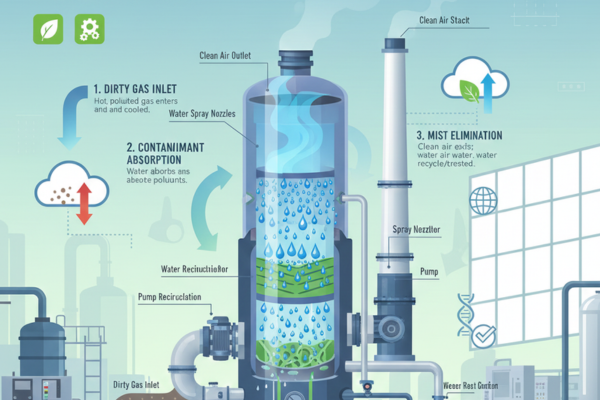
A wet scrubber is an air pollution control device that removes gases, fumes, and particulates from industrial exhaust by using a scrubbing liquid. The polluted gas stream passes through the scrubber where contaminants dissolve or get trapped, resulting in clean, compliant air emissions.
NAPCEN wet scrubbers are widely used in chemical processing, pharmaceuticals, metal finishing, incineration, mining, food processing, textile plants, and other industries handling acidic fumes or high-dust exhaust.
We manufacture a wide range of wet scrubbers including Packed Bed Wet Scrubbers, Venturi Scrubbers, HCl Scrubbers, Acid Fume Scrubbers, Chromic Acid Scrubbers, and Hospital Waste Incinerator Scrubbers.
Our scrubbers effectively remove acid fumes (HCl, H2SO4, HNO3), toxic gases, VOCs, chromic acid fumes, ammonia, chlorine, SO2, smoke, and fine dust particles.
Yes, all NAPCEN wet scrubbers are custom-designed based on airflow, gas composition, temperature, pressure drop, and industry-specific requirements.
We use high-quality corrosion-resistant materials such as FRP, PP, PVC, HDPE, and SS depending on the chemical application and operating conditions.